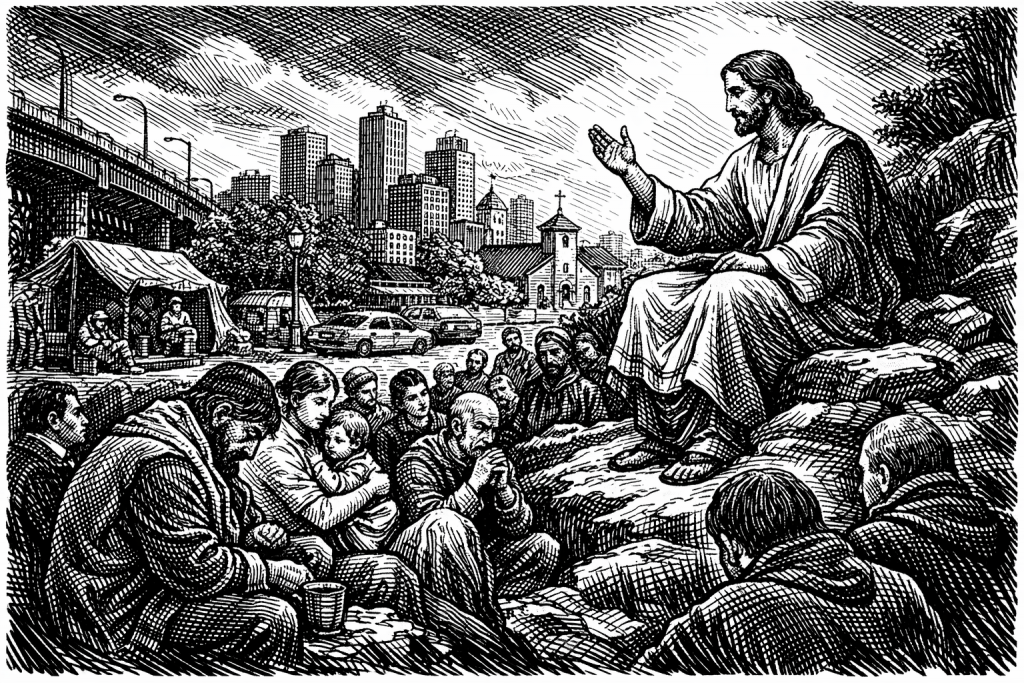
Blessed Are the Poor in Spirit
On this Fourth Sunday of Ordinary Time, the Church places before us one of the most challenging and beautiful passages in all of Scripture: the Beatitudes (Matthew 5:1–12). Jesus ascends the mountain, sits, and teaches. What follows is not a list of rules, nor a manifesto of power, but a quiet revolution of the heart.“Blessed are the poor in spirit,for theirs is the kingdom of heaven.”At first glance, the Beatitudes seem upside down. The world tells us that happiness belongs to the strong, the assertive, the successful, and the self-reliant. Yet Christ declares the poor in spirit, the meek, the merciful, the persecuted, to be truly blessed. This is not sentimental optimism; it is a re-ordering of reality itself.To be poor in spirit is not to be weak or defeated. It is to recognise our dependence on God. It is the humility that knows we are not self-made, not self-sustaining, not self-saving. In a culture that prizes autonomy and control, this humility is profoundly counter-cultural. And yet, it is here—precisely here—that the Kingdom of Heaven opens.The First Reading (Zephaniah 2:3; 3:12–13) echoes this truth. God promises to leave a humble and lowly people, those who take refuge in the name of the Lord. Not the loud. Not the proud. But the faithful remnant who trust rather than dominate.St Paul, writing to the Corinthians, drives the point home. God chooses what is weak in the eyes of the world to shame the strong. Not many were wise or powerful by human standards, Paul says—and that is no accident. Grace thrives where self-sufficiency dies.The Beatitudes are not simply ideals to admire; they are a portrait of Christ Himself. Jesus is poor in spirit, meek, merciful, pure of heart, and persecuted unto death. To live the Beatitudes, then, is not merely to behave differently—it is to become more like Him.This Sunday invites us to examine our own hearts. Where do we cling to control? Where do we measure blessing by comfort, speed, success, or approval? And where might Christ be calling us to slow down, to soften, to trust?True happiness does not come from grasping more, but from letting go. It does not come from winning, but from loving. It does not come from standing above others, but from kneeling before God.The mountain where Jesus teaches is not far away. We climb it every time we choose humility over pride, mercy over judgment, faith over fear. And there, quietly, the Kingdom of Heaven draws near.